At first glance, the digital signature is nothing new. After all, when a parcel is delivered to you, you already write your name boldly on a display. However, while the world of work has increasingly shifted to the Internet, the signature has long remained a paper tiger. Fortunately, the electronic signature has changed that - and it can do much more than just sign parcels.
The requirements for electronic signatures apply throughout the EU and therefore offer enormous potential for speeding up workflows and feedback loops. However, instead of relying on a single tool for this task, you should choose a solution that integrates the digital signature into your workflows in a meaningful and legally compliant way. This will save you time - and that of your clients!
So it's high time to integrate the digital signature into your internal processes and benefit from digitization as a tax consultant!
What is a digital signature?
The digital signature is a way of electronically signing contracts, annual financial statements and other important legal documents and processes throughout the EU in a legally secure manner. There are three different types of digital signature, which meet different legal requirements:
- Simple electronic signature
- Advanced electronic signature
- Qualified electronic signature
Is a digital signature valid?
In principle, a digital signature is legally binding. Whether an e-signature is valid in an individual case depends on which of the three forms of electronic signature was chosen and the type of document signed.
If, for example, a document requires certification or notarization and therefore personal attendance, then a handwritten signature is mandatory. Tax consultants, on the other hand, mainly rely on qualified electronic signatures.
Which is the right one: simple, advanced or qualified electronic signature?
Although the three variants of the electronic signature are all considered digital signatures, they are each in a class of their own. Which version is suitable for which purpose depends closely on how it is used. As a tax consultant, you have a legal responsibility, which is why you should definitely familiarize yourself with the finer points.
This much can be revealed in advance: For tax consultants, the highest security level (qualified electronic signature) is always the right choice when in doubt.
Incidentally, a digital signature does not have to look like a handwritten signature. Strictly speaking, it is a collection of data that is undoubtedly linked to the natural person. Thanks to external authentication procedures, such an electronic signature is something like a (digital) official seal: more like a coat of arms than the classic signature you are familiar with.
Simple electronic signature
The simple electronic signature, e.g. in the form of a scanned signature or email signature, offers you, as the name suggests, the lowest level of security. It is quick and easy to provide, but is therefore not suitable for all purposes, such as highly sensitive documents.
The risk of misuse is theoretically higher with simple electronic signatures, as an email signature, for example, can be created and used by anyone. There is no external authentication. However, you can approve an internal expense report or payment instruction with a simple signature with a clear conscience.
Advanced electronic signature
The advanced electronic signature has more legally binding force than the simple electronic signature - its use has a correspondingly greater scope. It is typically used for business documents and correspondence, i.e. offers, employment contracts and order confirmations with a medium legal risk.
This form of digital signature must be clearly assignable to the signatory and must not be able to be changed later without being noticed. This is ensured, for example, by linking the signatory and signature with a so-called verification key.
The advanced electronic signature is already a significant further development of the simple electronic signature. Nevertheless, it does not yet meet the highest security requirements because the form of authentication is not yet sufficient.
Qualified electronic signature
The qualified electronic signature (QES) is the form of digital signature that currently meets the highest security standards. It is also effective on documents that normally require a handwritten signature. Powers of attorney, for example, are just as effective with a qualified electronic signature as with a manual one.
For tax consultants and auditors, qualified electronic signatures are a priority when working for clients. After all, they work with highly sensitive information - and with the trust of their clients!
- A qualified electronic signature is issued digitally by a certified provider and linked beyond doubt to the signatory via a validation process. This can be done using the video identification procedure or with the electronic ID card.
- The technical basis for this is the secure signature creation device, which provides the encryption. One of the numerous online providers known as Trust Centers helps with this and with the subsequent authentication, i.e. ensuring that your e-signature and you belong together.
The qualified electronic signature therefore goes through a few essential steps before it is available and ready for use - but it is also almost completely secure against misuse. To simplify the process for you, you can rely on software solutions that integrate the QES seamlessly into existing workflows. This makes it intuitive to implement and use for both employees and clients.
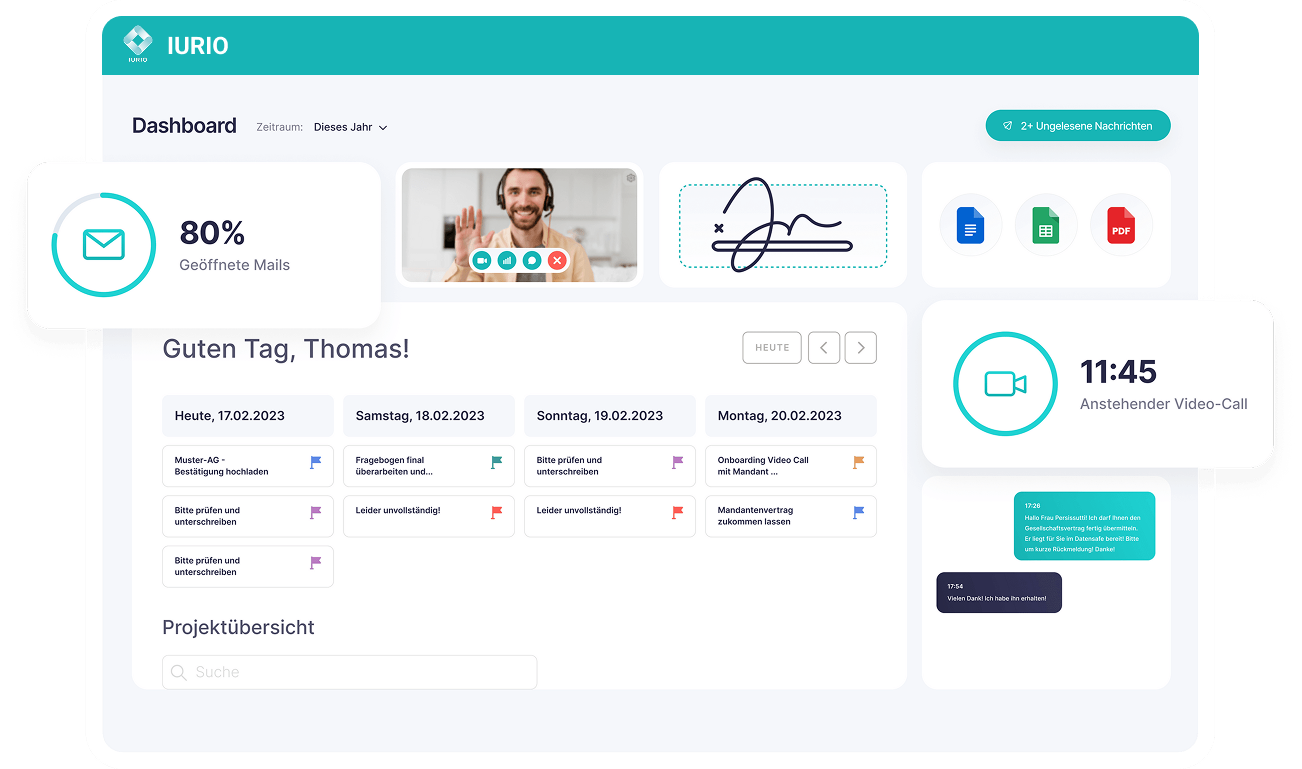
The Collaboration Suite such as DOCPIT offers the right digital working environment for this. It connects contact persons and clients and ensures seamless integration of the digital signature into all relevant processes and work steps. With the help of DOCPIT, your clients can create a qualified digital signature with just three clicks.
Your advantages: Create a digital signature as a plus for modern tax advice
Tax advice is based on seriousness, accuracy and in-depth knowledge of tax law; therefore, the highest standards should also apply when creating electronic signatures. The advantages of a digital signature are obvious for tax consultants who carry out legally sensitive activities:
- With a qualified electronic signature, you have the same legal security as with a handwritten signature.
- They meet all legal standards - in Germany, Austria and the entire EU.
- By switching to electronic signatures, you can save up to 78.6 percent on costs such as postage or archiving costs.
- You can save yourself and your team members client appointments for mere signing and concentrate on your core business.
- Reconciliation loops are shorter, as you only wait around 30 minutes for a response with the e-signature instead of up to 5 days - you can use the time you save for other purposes.
- You present yourself and your tax consultancy in a modern and service-oriented way, because your clients can sign their documents from anywhere.
- Your clients' time resources are spared, because a digital signature is faster than traditional "paperwork".
Use cases in practice: The digital signature for tax consultants
The option to create a digital signature is worthwhile for tax advisors if they want to position themselves as a forward-looking and service-oriented law firm. This is not just a "nice-to-have", but a real strategic advantage - especially if you rely directly on the integration of the qualified electronic signature. Typical areas of application for QES in tax consultancy are
- Income tax returns for your clients
- Commercial tax returns for your clients
- Advance sales tax returns
- Management reports & annual financial statements
- Shareholder resolutions of limited liability companies that do not pursue registration in the commercial register
Quick & secure solution: How do I create a digital signature?
To ensure that digital signatures make your day-to-day work easier and are accepted by your clients, it is important that you rely on a software solution that allows you to implement qualified electronic signatures as easily as possible. With DOCPIT, we have set ourselves the goal of making the process as intuitive and secure as possible for you and your clients:
- If you want to obtain a qualified electronic signature from your client, store the document to be signed in DOCPIT in the data safe
- There, your client has access to the document and can click on it
- A window opens in which the QES can be selected by clicking on it
- The document opens and your client clicks on the "Sign now" button
The following steps depend on whether your clients already use the digital signature. DOCPIT has interfaces to the largest and most important trust centers in the EU and the DACH region, so that your client can use their QES with confidence:
- The client now either selects their personal signature provider directly or nationality
- A selection of providers appears so that your client can select the relevant one and click on their Trust Center
- He can then simply drag the displayed signature into the document and sign it in this way
However, it is particularly interesting if your clients do not yet have a digital signature. If you do not yet have an electronic signature, you can create one in just a few steps via a Trust Center in around an hour before signing the document. As soon as the QES has been created, your clients can use it directly on the ISO-certified high-security platform DOCPIT.
Tax consultants also benefit from the fact that DOCPIT's tax consultant platform bundles collaboration internally and with clients centrally and combines all applications in an efficient workflow. Further advantages are
- ISO-certified high-security platform
- Secure data transfer & data exchange
- Smooth workflows in collaboration with employees & clients
- Integration of numerous European digital signatures
- Use of qualified electronic signatures
- ISO-compliant conversion of documents, e.g. PDF to PDF A 1b
- Working together on documents
We would be happy to show you in a free demo appointment what other advantages DOCPIT offers you as a tax consultant and how you can smartly integrate the software solution into your workflows.
Efficient workflows & digital signatures: tax consultants & their clients win with DOCPIT
The digital signature is an indispensable tool for tax consultants if you want to offer your clients a competitive, future-oriented service. With the electronic signature, you can speed up processes, optimize communication with your clients and carry out reconciliations more efficiently.
As a secure platform solution, DOCPIT offers you a strategic hub with an integrated digital signature for efficient collaboration within your team and with your clients. Thanks to the reliable integration of the qualified electronic signature, you can rely on the highest security standards.
If you are interested in a software solution to optimize your work processes and save time and costs, we look forward to hearing from you!