Every tax firm has numerous repetitive tasks that tie up staff capacity and cost time. Especially around tax appointments, missing documents or client data can quickly lead to stress and increasingly confusing communication.
Increasing digitalization in tax firms promises to put an end to endless paperwork and a flood of emails. Studies show that 85% of tax advisors have recognized the potential of digitalization and are increasingly relying on digital tools. 71 percent see digitalization as securing their future as tax consultants.
In practice, however, it is often the case that digital tools and solutions alone cannot solve the challenges faced by tax firms if they do not interact optimally and are not used systematically.
We will show you the challenges that tax consultants face in the course of digitalization and how you can use them to your advantage with the help of specific tips.
What is a digital tax office?
A digital tax firm is characterized by the fact that various areas of the firm such as business processes, accounting, tax advice itself and communication with clients and authorities are largely digitalized. This includes various software solutions, such as law firm software or a collaboration suite for secure data exchange and workflow management.
Using the right tools to digitize your tax firm
For tax consultants, digitalization means that work processes and consulting activities are moving ever closer to a paperless standard. Digital tools are already in use in many law firms, such as
- Law firm software for tax advice & client management
- Project management tool for the organization of the law firm
- Accounting software for payroll accounting & balance sheet preparation for your law firm
- Software for digital signatures in tax consulting
- Digital communication tools such as e-mail program or telephone system
- Collaboration suite to bring all isolated solutions together
Opportunities for tax advisors: understanding digitalization as added value
For you as a tax consultant, digitalization has the potential to make workflows and collaboration with your clients more efficient:
- Increase efficiency: With the help of digital project and task management tools, you can optimize and automate workflows, record and evaluate data in a structured manner and create analyses and forecasts at the touch of a button.
- Save costs and time: The more efficiently you can work, the more time you save when carrying out repetitive tasks, so that your employees are relieved and have more capacity available for advising and supporting your clients.
- Seamless communication: You can use digital tools to optimize communication with your employees and clients in order to avoid the typical "email ping-pong" and, for example, conduct video calls reliably and securely. This also allows you to work from home or provide advice from any location.
- Flexible data access: Digital solutions and cloud storage make it easier for you to collaborate and transfer data securely with employees, external contacts and clients so that you can edit documents together, for example.
- Innovative image: Both employees and clients are used to using digital tools on a daily basis and expect corresponding solutions from a tax firm. Digitalization helps you to enhance your image as an employer or tax advisor and gain a competitive advantage.
The challenges of digitalization: Tax firms in transition
As many opportunities as digitalization offers tax advisors, you should also be aware of the challenges that lie ahead. Digital tools have really shaken up the world of tax consulting and not all employees and clients are open to the changes.
One problem with many software solutions is that they are not intuitive to use, can hardly be customized and are highly complex. In addition, the tools are often used as fragmented stand-alone solutions that do not collaborate with each other. As a result, you not only lose an overview by constantly switching between programs, but also more time than you gain through digitalization.
Another challenge of digitalization is the security and data protection requirements for tax consultants as well as cybersecurity. Many common tools do not meet the professional requirements or GDPR compliance that are essential for tax firms.
5 tips for the successful digitalization of your tax firm
In order to fully exploit the business potential of digitalization as a tax consultant, you should consider a few points in view of the challenges:
- Understanding digitalization as a unique selling point (USP)
As a tax consultant, you already have expertise that makes your profession indispensable. If you combine this knowledge with digital know-how and efficient tools, you can gain a clear competitive advantage and a unique selling point within your industry. This can include, for example, offering an easy-to-use digital signature.
- Involve employees & clients in the process
In the course of digitalization, many tax advisors are concerned that either employees or clients do not want to use the digital tools or that they lack the know-how. This makes it all the more important that you closely support the introduction of new solutions and communicate the potential of the innovations to both parties in an understandable way.
- Pay attention to user-friendliness & intuitive operation
When choosing a digital solution, look for a self-explanatory user interface and intuitive operation. The easier it is for your employees and clients to use the tool, the higher the level of acceptance and the more efficient future collaboration will be.
- Use solutions with clear security standards
Security should always be the top priority in a digital tax firm. This includes ensuring that all solutions used are GDPR-compliant and rely on modern encryption technologies and European servers.
- Efficiently merging isolated solutions
Different activities within a tax firm require different, self-contained tools. However, it becomes problematic when you want to transfer information from one program to another or share data. A collaboration suite helps you to bring these tools together and establish a comprehensive, secure platform.
Effective & secure digitalization for tax advisors with a collaboration suite
The future of tax firms lies not only in digitalization, but above all in the smart use of digital tools for secure and efficient collaboration with your clients.
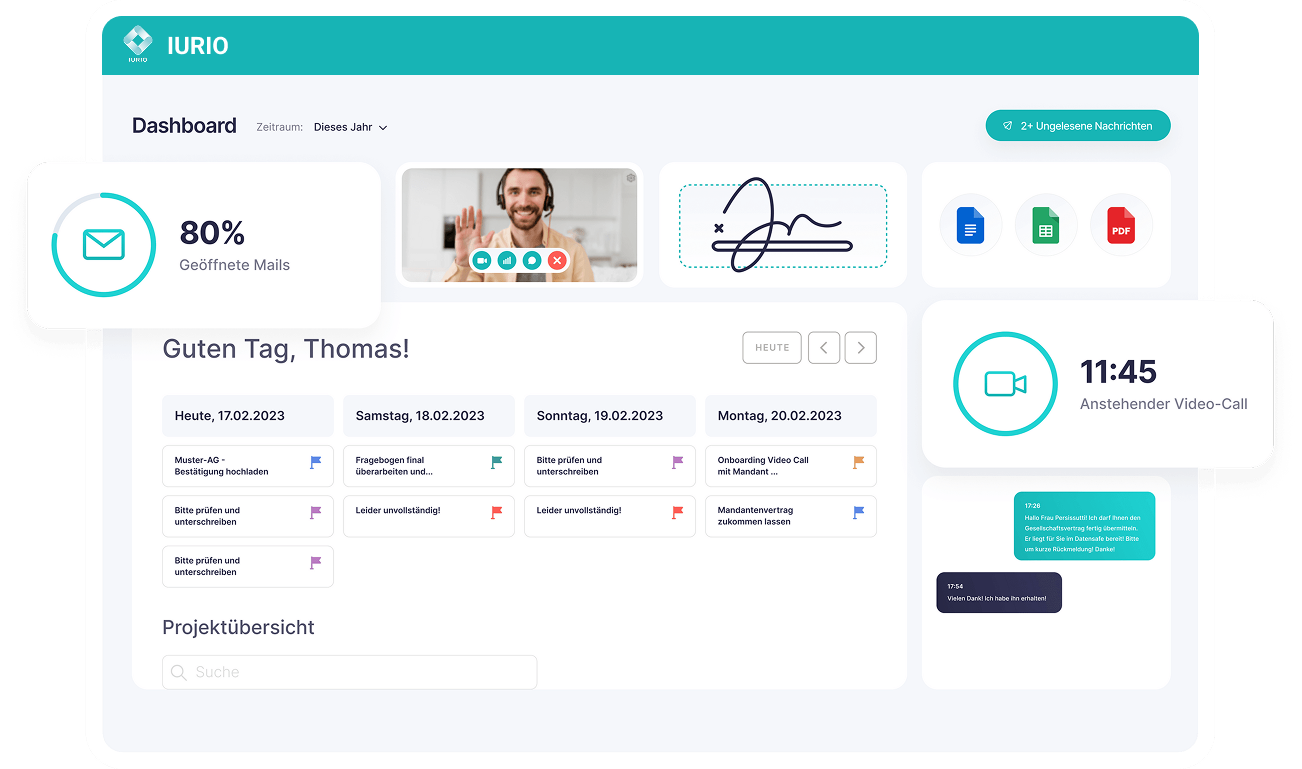
A solution such as DOCPIT's Collaboration Suite combines your current programs and tools via interfaces on a tax advisor platform for highly efficient communication and collaboration:
- Efficient communication with your clients saves up to 50 percent of the workload on average
- Bundle isolated solutions (e.g. e-signature, project management, web conferencing) without sacrificing relevant functions
- Interfaces to the most common law firm software (DATEV & BMD) and many other tools
- Modern encryption methods and 100% GDPR-compliant for guaranteed secure communication and data exchange
- Optimized workflows through Kanban boards, standardization and automation save resources
- Intuitive user interface so that DOCPIT can be used immediately without training
To ensure that DOCPIT's functions meet the special requirements of digital tax firms, we work closely with Linde during development. You also have the option of using DOCPIT as an on-premises solution.
If you would like to find out more about the cost-benefit advantages for your tax firm and experience the Collaboration Suite in action, please book a non-binding demo appointment.
"Yes" to digitalization: tax consultants secure their future with modern software solution
Digitalization is shaping the work of tax consultants and tax firms and characterizes the future prospects of the entire industry. Digital tools help you to collaborate and communicate more efficiently, thereby saving time and costs.
However, replacing manual tasks with software solutions is only the first step towards a digital tax firm. You can only make truly effective use of digitalization if you set up seamless interfaces between the various programs used and bundle communication between employees and clients on one platform.
A tool such as DOCPIT's Collaboration Suite enables you to bundle complex, fragmented isolated solutions and establish a highly secure basis for digital collaboration with all relevant contacts.
If you would like to find out more about the opportunities and challenges of digitalization for tax advisors, take a look at our blog or contact our team of experts.